Material choice determines the long-term behaviour of a shelving unit under load and under the environmental conditions specific to the room it occupies. In Poland, the retail market for shelf boards is dominated by particleboard, MDF, and construction-grade softwood. Birch plywood and solid hardwood are available but require sourcing from specialist timber merchants or online suppliers. Steel shelving components are widely available through general DIY chains.
Particleboard (płyta wiórowa)
Particleboard is the lowest-cost option and the most commonly used shelf material in Polish home retail. Standard thickness sold in Castorama and Leroy Merlin is 16–19 mm, typically pre-finished with a melamine or PVC edge trim. It is suitable for light to moderate loads in dry rooms.
Limitations of particleboard for shelving:
- Poor moisture resistance. Swells irreversibly when exposed to humidity above 70%. Not suitable for kitchens without sealed edges and surfaces.
- Reduced holding strength for screws near edges, especially thin edges. Shelf pin holes in particleboard should use metal sleeves (euro screws) or the holes will enlarge under cyclic load.
- Heavier than plywood for the same structural performance.
Moisture-resistant (MR) grade particleboard, identified by a green-tinted cross-section, offers improved humidity tolerance. It is available at most Polish DIY chains and is appropriate for kitchen use provided surfaces and edges remain sealed.
MDF (płyta MDF)
Medium-density fibreboard has a uniform, smooth surface that paints and veneers cleanly. It machines well for routed edges and decorative profiles. For shelving, its main advantage over particleboard is better edge screw holding and a more consistent density throughout the board.
Standard shelving MDF in Poland is 18 mm thick. Moisture-resistant variants are available. The key practical limitation: MDF is denser than particleboard and adds more weight to a wall-mounted system. For a long run of deep shelves (e.g., 5 shelves at 1200 mm × 350 mm × 18 mm MDF), the cumulative weight is worth calculating before deciding on anchor types.
Solid wood shelf with wooden brackets — a common approach in Polish homes. Image: Wikimedia Commons (CC BY-SA).
Birch plywood (sklejka brzozowa)
Birch plywood is the material most often recommended by furniture makers for shelving that needs to combine strength with lighter weight relative to particleboard and MDF. A 15 mm birch ply shelf spanning 900 mm is more resistant to sag under book loads than an 18 mm MDF shelf of the same width.
In Poland, birch plywood is not widely stocked in large-format DIY retailers. It is available from timber merchants (tartak) and specialist wood suppliers, and through a growing number of online platforms that cut to order. Standard sheet size is 2440 × 1220 mm; thicknesses commonly available: 9, 12, 15, 18, 21 mm.
The exposed edge of birch ply is the material's visual signature — stacked alternating layers of birch veneer. This edge is often left visible intentionally in contemporary shelving designs. Finishing with a clear wax or oil preserves the look while sealing the surface.
Solid pine and other softwoods
Solid pine (sosna) is available in most Polish DIY chains as pre-cut shelf boards in widths from 100 to 400 mm and lengths from 600 to 2000 mm. Pine is denser than it appears and has a natural resin content that provides limited moisture resistance when sealed.
Pine boards sold for shelving in Poland are typically kiln-dried to around 12–14% moisture content. In rooms with seasonal humidity variation (which is normal in Polish apartments without air conditioning), slight movement is expected. Floating fixings or end clearance gaps prevent stress cracking over time.

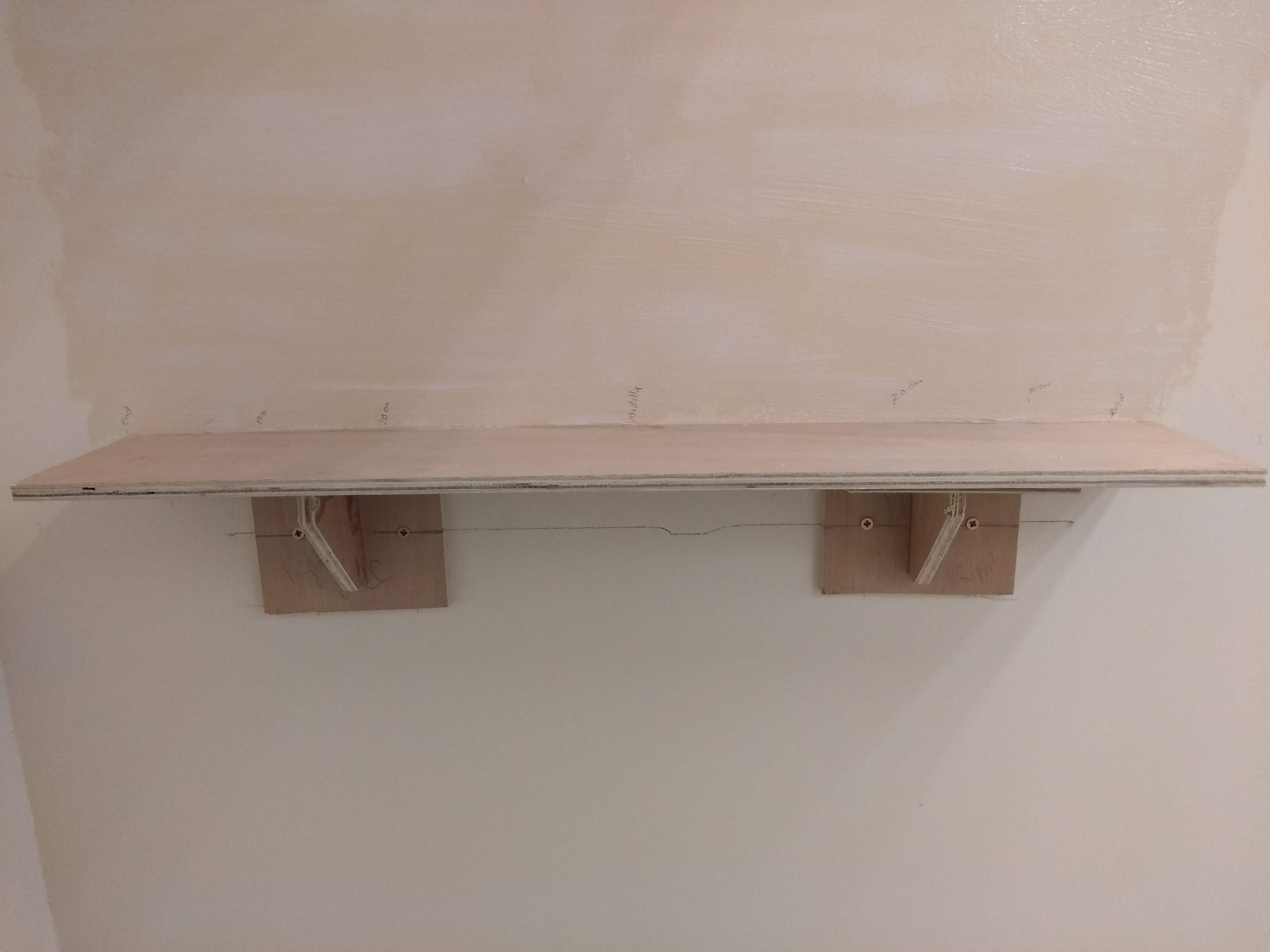
Angled view showing bracket-to-wall attachment detail. Image: Wikimedia Commons (CC BY-SA).
Steel bracket systems
Steel components enter shelving systems primarily as brackets and, in track-based systems, as vertical uprights. In Poland, track systems by brands such as Hettich are available through specialist hardware suppliers. The generic pressed-steel angle bracket sold in every hardware shop (kątownik) serves fixed installations.
Powder-coated steel brackets are rust-resistant in dry rooms. For kitchens or rooms near exterior walls where condensation can occur, hot-dip galvanised or stainless-steel hardware is more appropriate.
Humidity considerations in Polish apartments
Polish apartments, particularly in older panel-block construction, can experience relative humidity variations between 30% in winter (central heating with no humidifier) and 65–70% in summer. Untreated softwood and raw MDF edges are sensitive to this range. Surface treatment — oil, wax, lacquer, or water-based varnish — reduces but does not eliminate dimensional movement in solid wood.
For kitchen shelving, particleboard with ABS edge banding and a full-surface laminate coating is the most humidity-tolerant option available at standard Polish retail pricing. Teak and other tropical hardwoods have natural oils that make them inherently moisture-resistant, but their availability and cost make them an uncommon choice for general shelving in Poland.