Designing a shelving system before purchasing materials prevents the most common errors: boards that sag under books, brackets placed through hollow sections of a masonry wall, and unit dimensions that obstruct ventilation or doors. The planning phase involves four measurable decisions: overall unit dimensions, shelf span between supports, bracket spacing on the wall, and maximum load per shelf.
Overall unit dimensions
In Polish apartment construction, ceiling heights in buildings erected between 1960 and 1990 (the era of prefabricated panel construction, known locally as wielka płyta) are typically 250–260 cm. More recent construction ranges from 260 to 300 cm. Full-height shelving units that run from floor to ceiling need a clearance gap of 10–15 mm at the top to allow for slight seasonal movement of solid wood components.
Shelf depth is dictated by intended content. Standard reference dimensions:
- 250 mm — paperback books, small objects, spice jars
- 300 mm — standard hardcover books, A4 binders, medium kitchen storage
- 350–400 mm — art books, monitors (when used as a desk shelf), workshop items
- 500 mm — wardrobe-depth storage; requires a lip or rear stop to prevent items falling
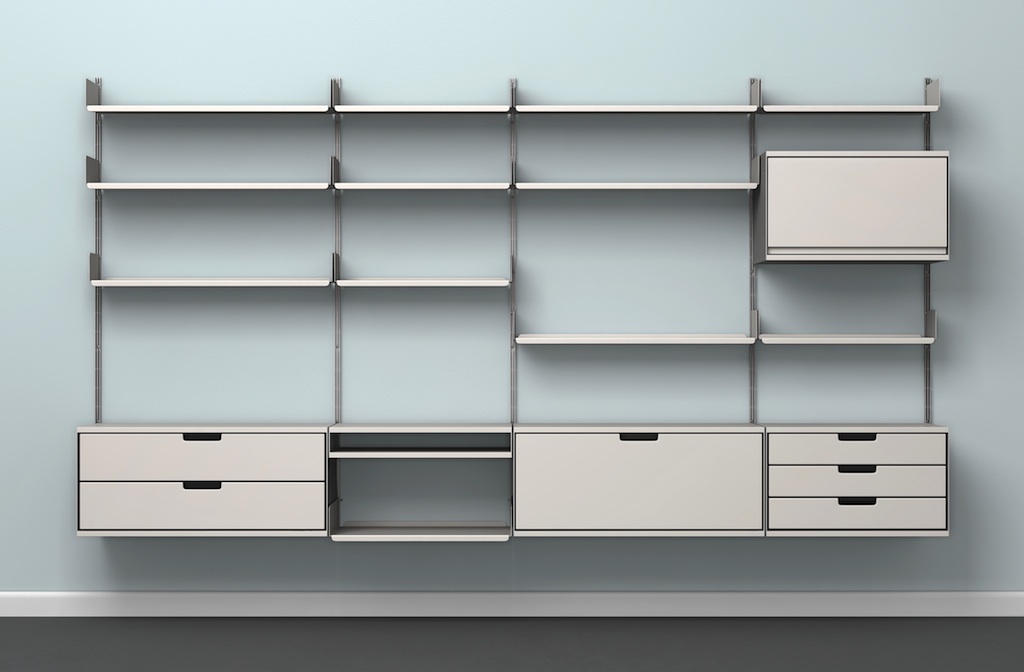
The 606 Universal Shelving System by Dieter Rams, first produced in 1960. Its uprights and shelf pins demonstrate the core principle of adjustable modular shelving. Image: Wikimedia Commons (CC BY-SA).
Shelf span and sag
The most frequently underestimated variable in DIY shelving is deflection — the downward bend of a board under sustained load. A shelf that holds 30 kg of books will visibly sag if the span between supports exceeds what the material can bear.
For 19 mm particleboard (the standard thickness sold in Polish DIY chains such as Castorama and Leroy Merlin), a span of 600 mm is considered safe for book loads. At 800 mm, the same board will deflect noticeably over time. Adding a 6 mm hardboard backing bonded to the underside of the shelf significantly reduces deflection without adding visible bulk.
The practical rule: keep unsupported spans under 800 mm for particleboard and MDF carrying books. For solid pine (18–22 mm), 900 mm is workable. For 18 mm birch plywood, 1000 mm is possible before visible sag becomes an issue under full book load.
Bracket spacing on the wall
Brackets should be positioned so that loads transfer cleanly into the wall anchor points. Two errors are common in DIY installations: placing brackets too close to the shelf ends (leaving the middle span unsupported) and spacing them so far apart that the brackets themselves become the failure point.
A practical approach for single-shelf installations:
- Place brackets at 100–150 mm from each end of the shelf.
- Add intermediate brackets if the span between the two end brackets exceeds 800 mm.
- For adjustable track systems (e.g., Elfa, Hettich, or Polish-market equivalents), use the manufacturer's recommended upright spacing — typically 400–600 mm.
Load capacity calculation
Load capacity of a shelf system depends on both the shelf board and the wall anchors. For masonry walls (concrete block or reinforced concrete panels common in Polish panel buildings), a single expansion bolt or chemical anchor in good-quality substrate can support 40–80 kg depending on bolt diameter and hole depth. Plasterboard walls require either stud anchors or toggle bolts, with significantly lower individual anchor capacities (typically 15–30 kg per anchor point).
Before planning load, identify the wall substrate:
- Knock on the wall. A hollow sound indicates plasterboard or hollow block.
- A solid, dense thud suggests reinforced concrete or filled block.
- In prefabricated panel buildings (panelaki), exterior and structural walls are reinforced concrete; partition walls are often hollow lightweight block.
Modular track systems vs. fixed brackets
Track-and-bracket systems consist of vertical rails fastened to the wall and horizontal brackets that clip or slot into the rails at adjustable heights. The main practical advantage: shelf positions can be changed without re-drilling. The main limitation: the rails are visible and contribute to the aesthetic of the unit.
Fixed-bracket systems require a bracket to be individually anchored to the wall at a permanent position. Repositioning means filling old holes and drilling new ones. However, they are generally cheaper per bracket and less visually prominent when the bracket is painted to match the wall.
For rooms expected to have changing storage needs — a child's room, a home office — track systems are more practical. For a kitchen where shelf positions will not change, fixed brackets are sufficient.